I. Damage Classification and Selection of Repair Methods
- Minor damage: Surface rubber scratches or tiny pinhole leaks only; canvas reinforcement layer remains intact. Repair using a single-sided cold-bonded reinforcement patch.
- Moderate damage: Penetration of the rubber layer, localized abrasion exposing the canvas, or small tears (under 20cm); a double-sided (internal and external) reinforcement patch method is recommended.
- Severe damage: Large-scale tears, canvas rupture, or through-thickness damage in high-stress zones (such as the abutment area); repair via splint reinforcement or partial section replacement.
- Emergency damage: Sudden water spraying or leakage during operation; prioritize temporary sealing to control the hazard, followed by permanent repair after deflating and lowering the dam.
II. Prerequisites for Repair
Before repair work begins, the dam's internal medium must be drained, the dam lowered and flattened, and the damaged area cleaned. The base surface must be completely dry and free of silt, moss, and oil/grease. The optimal ambient temperature for construction is 18°C~25°C; bonding operations must not be performed in humid, rainy, snowy, or windy conditions. The material, number of layers, and warp/weft orientation of the reinforcement patches must match those of the original dam body.
III. Core Repair Processes by Classification
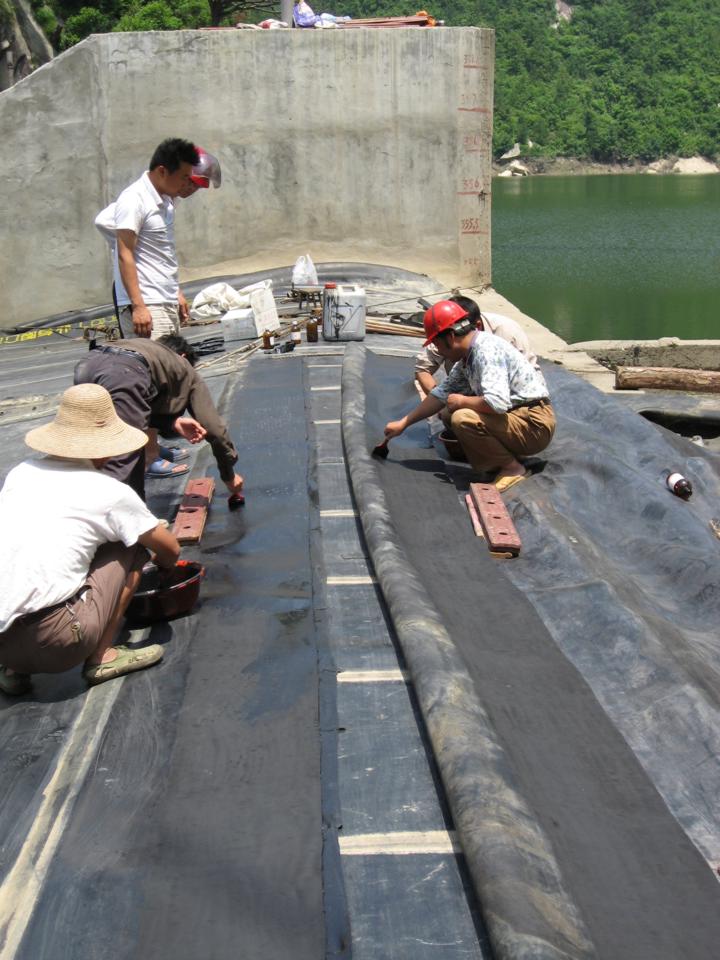
- Minor damage repair: Abrade the area surrounding the damage and degrease using anhydrous ethanol; apply multiple thin coats of specialized adhesive, allowing each coat to dry thoroughly before applying the reinforcement patch; use a pressure roller to expel air bubbles, seal the edges with edge-sealing adhesive, and allow to cure undisturbed for at least 24 hours.
- Moderate damage repair: Trim away loose or aged rubber edges at the damage site and expand the abrasion area; apply reinforcement patches to both the inner and outer surfaces, aligning the warp and weft directions; roll thoroughly to expel air bubbles and apply a wider edge seal; cure at ambient temperature for at least 48 hours; do not inflate the dam during the curing period.
- Major Repair: After applying and curing reinforcement patches to both the interior and exterior of the damaged area, stainless steel clamping plates are installed to provide compression and reinforcement. If the damaged area is extensive, the damaged section is cut out and replaced with a patch of the same specification; reinforcement and sealing are applied to both sides, followed by a pressure test upon completion.
- Emergency Repair: In the event of sudden leakage during the flood season, rubber plugs and temporary clamps are used to rapidly stop the flow and contain the hazard; permanent repairs are deferred until the non-flood season when the water supply can be shut off.
IV. Repair Construction Precautions (Critical Points Prone to Rework)
- Bonding must not be performed on damp or wet surfaces, as this frequently leads to subsequent debonding;
- Adhesive paste must not be applied in a single thick layer; instead, multiple thin coats should be applied;
- Reinforcement patches must be oriented correctly regarding warp and weft directions; incorrect orientation leads to uneven stress distribution and re-tearing;
- Pressurization (via water or air filling) is strictly prohibited before the curing period is complete;
- No air bubbles may remain in the bond interface; voids or "hollow spots" can allow water ingress and lead to delamination.
V. Acceptance and Subsequent O&M
Once the repair has cured, the dam bag is slowly inflated in stages and held at a stable pressure for 30 minutes; acceptance is granted if the repaired area shows no signs of leakage, bulging, or edge separation. Routine O&M involves regularly clearing sharp debris (such as sand, gravel, or stones) from the base of the dam bag and conducting comprehensive inspections before and after the flood season; minor damage should be repaired promptly to prevent the defect from worsening.