
In the overall structure of a inflatable rubber dam, the dam sides (the end caps at both ends of the dam bag) are the critical components with the highest stress concentration, highest failure rate, and most stringent technological requirements.
Compared to the main dam body, the dam head is subjected to long-term water pressure compression, repeated expansion and collapse bending, side water-stop friction, and shear force from the anchoring structure, making it a high-risk area for cracking, delamination, seepage, and bulging in inflatable dams.
Many inflatable rubber dams have short service lives and leak at the ends, the root cause of which is the substandard vulcanization process at the dam head, inadequate wrapping, insufficient reinforcement, and the presence of dead-angle stress.
This article, based on the "SL227-2014 Rubber Dam Technical Specification," explains in detail the standard dam sides hot vulcanization process, construction procedures, key technical points, and acceptance standards. It is applicable to project procurement, technical briefings, construction approval, and quality acceptance.
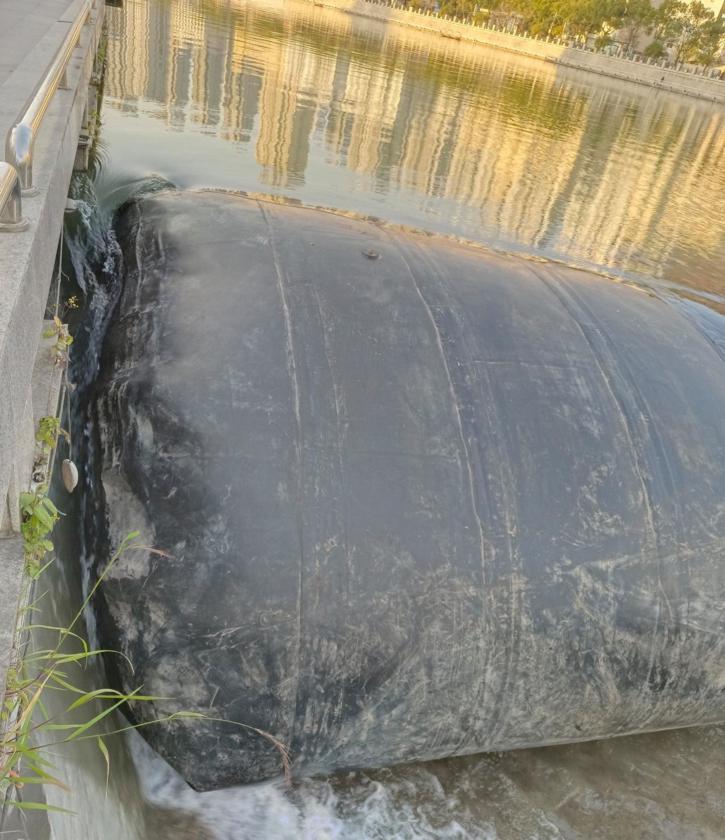
Inflatable rubber dam sides are the closed ends of the dam bag on both sides, undertaking three core functions:
To achieve complete water stoppage at both ends of the river channel, preventing lateral seepage;
To withstand high-frequency bending fatigue caused by repeated inflation and dam collapse;
To achieve overall sealing in conjunction with the sidewall water-stopping system and anchoring system.
Industry-mandated regulations: Dam heads for new dams must be manufactured using factory-integrated hot vulcanization; on-site cold bonding is strictly prohibited!
Cold bonding is only suitable for later repairs and cannot be used for manufacturing new dam sides; otherwise, delamination, peeling, and leakage will inevitably occur within 1~3 years.
Ordinary small factories directly cut the canvas, resulting in exposed fibers, water ingress corrosion, and delamination/bulging.
The standard process employs a multi-layered, stepped inward folding technique:
Each layer of canvas at the dam head is folded inwards sequentially, staggered to seal;
All canvas fiber ends are completely encased in rubber, with zero exposed ends;
This prevents water from seeping into the fabric layers, thus preventing hydrolysis, rotting, and delamination between layers.
This step is crucial in determining whether the dam head can last 8~10 years or more.
Right-angle folds at the dam side are a major manufacturing defect, easily causing stress concentration and repeated bending breakage.
Standard process requirements: All corners at the dam side must be rounded to avoid sharp right angles, dispersing bending fatigue stress and significantly improving bending lifespan.
The dam side is a reinforced load-bearing area and requires double-layer reinforcement:
Apply an additional thick layer of raw rubber reinforcement evenly to the inner and outer sides of the dam side;
Fill all gaps and folds in the dam side with specialized raw rubber;
Prevent voids, inclusions, and air bubbles in the layers.
Through this thickening reinforcement, the problem of localized stress weaknesses in the dam sides is solved, improving water pressure resistance and tear resistance.
The dam side must be vulcanized using a specialized mold with strictly fixed parameters:
Vulcanization Temperature: 145℃~150℃
Vulcanization Pressure: 1.8MPa~2.2MPa
Constant Temperature and Pressure Holding: Based on the thickness of the rubber sheet layers, maintain the required time.
This ensures full cross-linking of the rubber and canvas molecules, resulting in a seamless, unified structure after vulcanization, without delamination, soft rubber, or under-vulcanization.
This eliminates the common practice of using "low-temperature fake vulcanization" or "rapid vulcanization" to cut corners.
After vulcanization, rapid demolding and cooling are prohibited. Slow cooling and shaping within the mold are required to eliminate internal thermal stress and prevent dam side deformation, warping, and uneven local tension.
The edges of the dam head are neatly trimmed, without burrs or thin edges.
Soap water is applied to the entire dam side for leak detection.
Pressure testing is performed; no bubbles or leaks at the dam head indicate it is "qualified".
High-standard water conservancy, landscape water storage, and high dam projects utilize a one-time integral vulcanization process for the dam body and dam sides:
No secondary splicing seams between the dam head and dam body;
No weak surfaces from secondary bonding;
Optimal overall strength, seepage prevention performance, and anti-aging performance;
This is currently the preferred technology for key municipal projects.
No exposed canvas at the dam abutment; all fiber ends are fully sealed and wrapped.
The dam abutment vulcanization is full, without bubbles, delamination, cracks, or hard folds in dead corners.
The peel strength of the vulcanized joint is ≥6.0 kN/m, and the overall strength is ≥85% of the parent material strength.
The rounded transition is smooth, and stress is reasonably distributed.
The pressure test at the dam abutment shows zero leakage and zero bubbling.
1. Canvas directly cut and exposed: Short-term water ingress leads to delamination, bulging, and delamination;
2. Right-angle hard folds without rounded edges: Repeated bending causes cracking, halving lifespan;
3. No reinforcing rubber: The dam head is too thin, insufficient pressure resistance, and easily torn;
4. Low-temperature under-curing: Rubber softens, is not wear-resistant, and ages and cracks rapidly;
5. On-site cold-bonding of the dam head: Leakage and delamination are inevitable within 1~2 years.
The durability of inflatable rubber dam sides depends not on the thickness of the rubber, but on the standardization of the vulcanization, folding, and reinforcement processes.
Hot vulcanization in a reputable factory, stepped folding, rounded transitions, double-layer reinforcement, and standard high-temperature and high-pressure vulcanization are the fundamental guarantees for long-term leak-proof, crack-free, and maintenance-free dam heads.
For project procurement and construction acceptance, prioritize the overall hot vulcanization dam head process and reject inferior processes such as simple cold bonding, right-angle folding, and exposed cutting edges.


Hello, I am the online customer service


